Private Cloud Compute gets audited. Your saved Siri conversations get Apple's word.
So I updated to iOS 27 last week and asked the new Siri how my conversations are saved. The first protection it pitched was Private Cloud Compute.
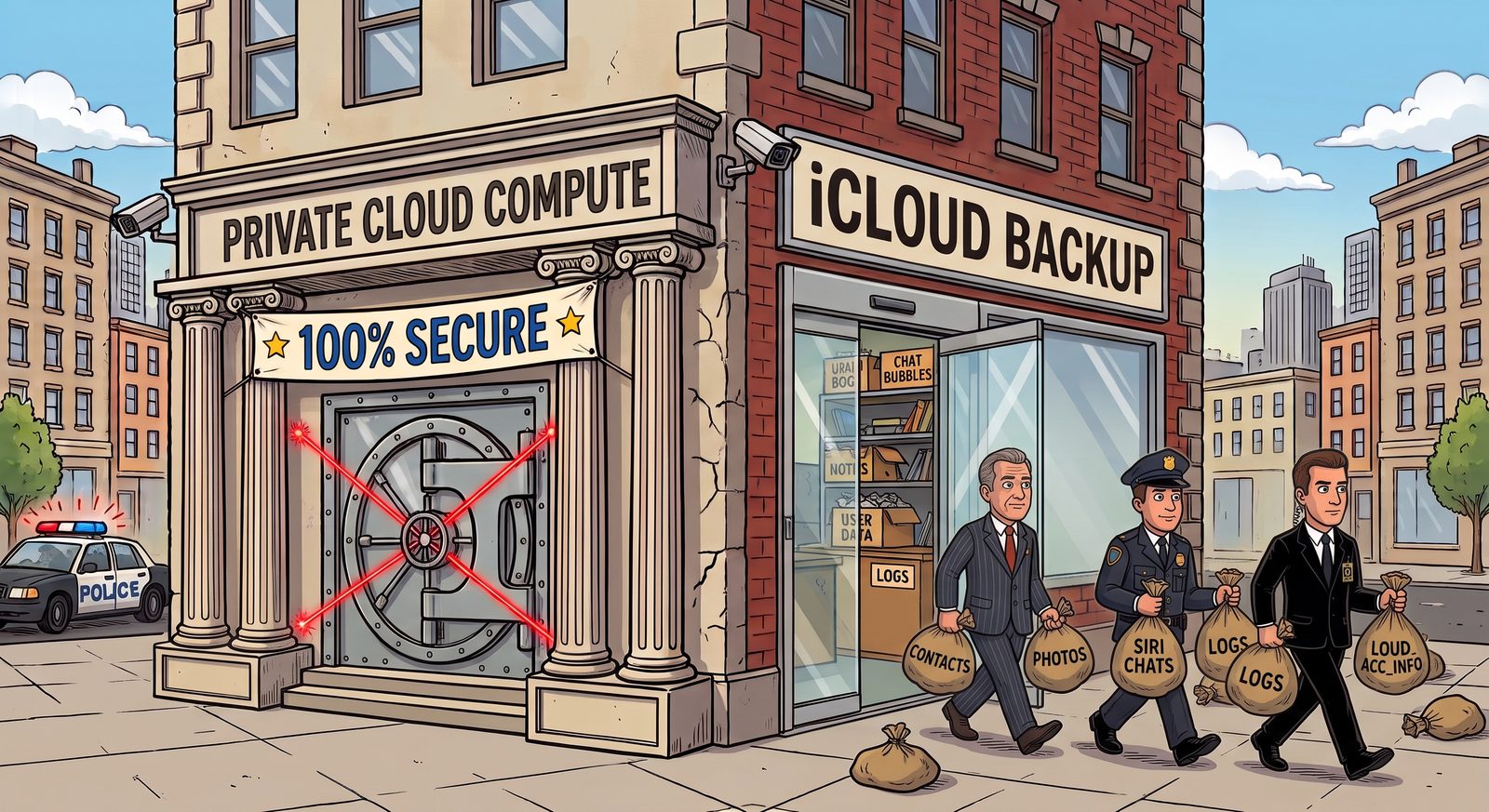
That’s Apple’s pitch too, and PCC deserves it. But PCC only covers the moment your request gets processed. The conversation itself is saved and synced somewhere else, under a different set of rules, backed by a different kind of promise.
Two kinds of promise
Private Cloud Compute is the part of Apple Intelligence that runs on Apple’s servers. It processes your request and throws it away. And Apple doesn’t just say so. It publishes the architecture, ships a research environment so outsiders can inspect the software, pays up to $250,000 for a bug that exposes a user’s request data, and puts out an independent SOC 3 audit every quarter.
That’s a verifiable promise. You don’t have to take Apple’s word for it.
Now the part that actually keeps your conversations. iOS 27 gave Siri its own app, with your full history saved on your phone and synced through iCloud to your other devices. Apple’s in-app privacy doc says that sync is end-to-end encrypted and “cannot be read by Apple.”
That’s a good design on paper. It’s also a claim. There’s no research environment for it and no audit I could find that covers it. Apple writes the software that does the encrypting and ships the updates that can change it. You’re trusting Apple’s word, which is exactly what PCC was built so you wouldn’t have to do.
And Apple didn’t lead with even that. The iOS 27 announcement says the Siri app syncs your history “privately.” The legal pages on apple.com don’t mention the sync’s encryption at all. The end-to-end line lives in a document you have to open in Settings.
The rules on your phone
The copy on your phone follows your phone’s rules, not PCC’s. It’s there in full, as a scrollable history, for anyone who has your unlocked device. That’s not a flaw so much as a different trade-off. But it’s a long way from “processed and discarded.”
Backups are the other open question. On standard iCloud protection, which is the default, Apple holds the keys to your iCloud backups and its law enforcement guidelines say it provides them with a warrant. Apple doesn’t say whether your Siri history is part of that backup or only travels through the encrypted sync. Advanced Data Protection puts backups under end-to-end encryption too, but it’s off by default.
The part that isn’t encrypted from Apple at all
None of the above covers requests that go to Apple’s regular servers instead of PCC. These are all from Apple’s own privacy pages, most of them updated the day iOS 27 shipped.
- Stored transcripts. When a request is handled on Apple’s servers but not in PCC, Apple stores the transcript for up to two years. A reviewed subset can be kept longer. That’s the first sentence of Apple’s Siri privacy page.
- More than the words. Apple also keeps the request category, your device details, and your approximate location. Siri may send along your contact names and relationships, the names of people in Photos, your Home setup, and the apps you have installed.
- Training, by default. Transcripts may be used to fine-tune Siri, Search and speech recognition models. No opt-in required.
- Human reviewers. Graders read a sample of transcripts, and Apple says a reviewer may see your contacts’ names or your installed apps.
- The opt-in. If you tap Agree on iOS 27’s new setup prompt, Apple may keep all your Siri interactions, including audio, Siri’s responses, and the history saved in the Siri app, and use them to train its foundation models. I tapped Not now.
These requests are tied to a random identifier instead of your Apple Account. That’s the protection. But they’re stored, read and trained on, by Apple’s own description.
Apple’s pages don’t even agree on how long that identifier sticks. The legal pages say it rotates “multiple times per hour.” The Privacy Features page says requests stay tied to it for six months and can be deleted from Apple’s servers.
What “private” means here
PCC is private in the strongest sense a cloud service can be: you can check. Everything else Siri keeps runs on weaker promises. Some of it is end-to-end encrypted on Apple’s word. Some of it sits in a backup Apple can open by default. And some of it is stored as plain transcripts on Apple’s servers for up to two years.
Apple keeps pointing at the part you can verify. The rest you’re asked to trust.
If you want to tighten what you can:
- Settings > Siri > About Siri, Dictation & Privacy. Read it. It says more than Apple’s website does.
- Settings > Privacy & Security > Analytics & Improvements. Turn off the Siri improvement toggle.
- Settings > [your name] > iCloud > Advanced Data Protection. It encrypts your backups end to end. It won’t touch anything on Apple’s regular servers.
Sources: Apple, “About Siri, Dictation & Privacy” (in iOS 27 Settings). Siri AI announcement (Sept 2026). Siri, Dictation & Privacy, Improve Siri & Apple Intelligence & Privacy and Apple Intelligence & Privacy (all 14 Sept 2026). Privacy Features. iCloud data security overview (Jan 2026). Legal Process Guidelines, US (Oct 2025). Security research on Private Cloud Compute. PCC SOC 3 audit reports.